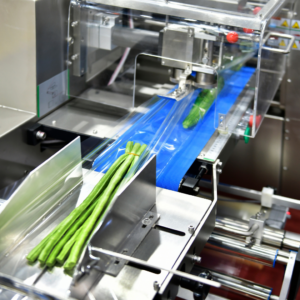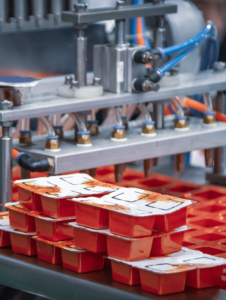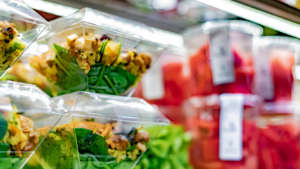

Speed has always mattered in food manufacturing.
But today, it’s everything.
Production lines are moving faster. Labor is harder to secure. Product variety is expanding. And expectations around consistency, safety, and efficiency continue to rise. In this environment, automation is no longer a future investment. It is a present-day requirement.
But here is what often gets overlooked.
Automation does not succeed on equipment alone.
It succeeds on packaging.
The Real Bottleneck Isn’t Always the Machine
Many food manufacturers invest heavily in automated equipment expecting immediate gains in throughput and efficiency. But when packaging is not designed for that environment, performance quickly breaks down.
Films do not feed consistently.
Seals fail under speed.
Materials jam, stretch, or misalign.
And suddenly, the line that was supposed to increase output becomes a source of downtime.
The reality is simple.
Packaging is not just part of the process. It is a critical driver of how well automation performs.
Packaging Built for Speed
Automation changes the requirements of packaging at a fundamental level.
Materials must perform consistently at high speeds, often with little margin for variability. Structures need to maintain integrity under pressure, temperature, and rapid movement. Even small inconsistencies can create ripple effects across an entire line.
At the same time, packaging still needs to do everything it always has:
Protect product quality
Maintain food safety standards
Support distribution demands
Deliver on shelf expectations
Balancing these requirements is where many operations struggle.
Because packaging is no longer just about containment.
It is about performance.
Why Material Selection Matters More Than Ever
In automated environments, material selection becomes a strategic decision.
The right film structure can mean smoother runs, fewer stoppages, and more consistent sealing. The wrong one can slow production, increase waste, and create ongoing operational challenges.
And the differences are not always obvious.
Two materials may look identical on paper, but perform very differently on a high-speed line. Subtle variations in thickness, friction, or seal properties can impact how packaging behaves in real-world conditions.
That is why packaging decisions cannot happen in isolation.
They need to be grounded in how the line actually runs.
Automation Is Not One-Size-Fits-All
Every food manufacturing environment is different.
Protein processing lines have different demands than snack packaging. Fresh produce operations move differently than prepared meal production. Frozen foods introduce their own set of constraints.
Automation needs to reflect those realities.
That includes:
Understanding the specific equipment in use
Aligning materials with machine capabilities
Accounting for sanitation requirements and washdowns
Planning for variability in product and packaging formats
When these factors are aligned, automation works as intended.
When they are not, even the best equipment can fall short.
The Cost of Getting It Wrong
When packaging and automation are not aligned, the impact shows up quickly.
Increased downtime
Higher material waste
Inconsistent output
More manual intervention
And over time, those issues compound.
What starts as a minor inefficiency becomes a recurring operational challenge. Teams spend more time troubleshooting than optimizing. Production targets become harder to hit. Costs increase in ways that are not always easy to trace back to packaging.
This is where the gap often exists.
Not in the equipment.
But in how everything works together.
A More Connected Approach to Packaging and Automation
The most effective operations take a more integrated approach.
Packaging is evaluated alongside equipment, not after.
Materials are tested based on real-world performance, not just specifications.
Decisions are made with both production and downstream distribution in mind.
This creates alignment across:
Material selection
Equipment performance
Operational efficiency
Product protection
And ultimately, it leads to better outcomes.
Fewer disruptions.
More consistent throughput.
Stronger overall performance.
What This Means Moving Forward
Automation will continue to reshape food manufacturing.
Lines will get faster.
Product formats will continue to evolve.
Operational pressure will not slow down.
In this environment, packaging becomes even more important.
Not just as a protective layer.
But as a performance driver.
The manufacturers that get this right are not just investing in automation.
They are aligning packaging, equipment, and operations into a system that works together.
That is where real efficiency is built.
Ready to Take a Closer Look at Your Packaging Performance?
If your operation is investing in automation or looking to improve line efficiency, it starts with understanding how your packaging is performing in the real world.
Reach out to our team to evaluate your current packaging, identify opportunities, and build solutions designed to run the way your operation needs.